The 2026 Toyota Tacoma TRD Off-Road delivers a strong balance of capability and value in the lineup. It comes standard with essential trail equipment—including an electronically controlled locking rear differential, Bilstein monotube shocks with piggyback reservoirs, Multi-Terrain Select, and Crawl Control—without requiring the higher expenditure associated with top-tier overlanding models.
For enthusiasts evaluating overall value, the TRD Off-Road grade provides serious mechanical muscle right out of the box. Powered by the standard i-FORCE 2.4-liter turbocharged engine producing 278 hp and 317 lb-ft of torque, or the available i-FORCE MAX hybrid system generating 326 hp and 465 lb-ft of torque, this trim handles highway pavement and trail obstacles with equal confidence. Lower trims like the SR5 offer a solid baseline for general utility, but they lack the factory locking differential and dedicated terrain electronics that make trail driving predictable.
Moving above the TRD Off-Road brings you to specialized grades like the Trailhunter and TRD Pro. While those upper variants add equipment like Old Man Emu dampers or FOX internal bypass shocks, they also push pricing significantly higher. The TRD Off-Road trim remains the sweet spot for drivers who want factory-backed engineering, strong resale value, and genuine trail agility.
Whether you are navigating gravel access routes near Mount Pleasant or taking a weekend trip across Middle Tennessee, having dedicated chassis hardware backed by factory warranties gives you complete peace of mind. To explore available trim options and test drive a pickup in person, visit our Columbia showroom or give our sales team a quick call to check incoming availability.
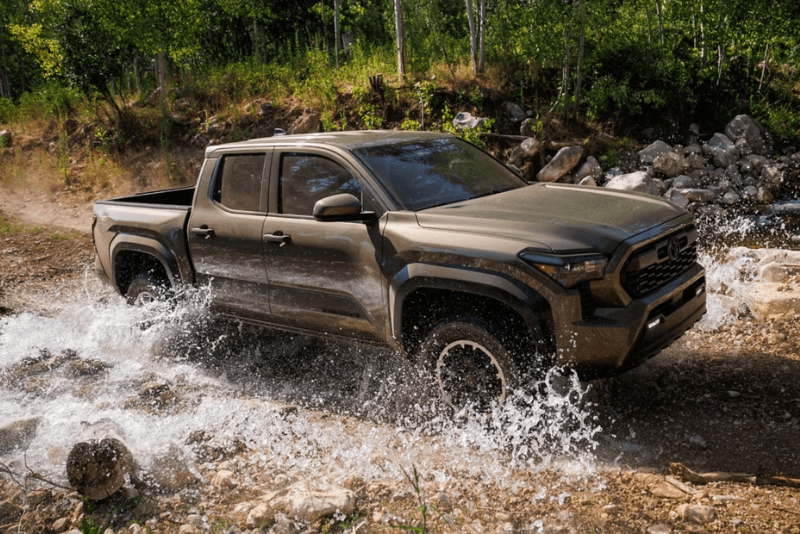
How Does Toyota's Multi-Terrain Select System Work on the Tacoma?
Toyota’s Multi-Terrain Select system functions by adjusting engine throttle response, transmission shift logic, wheel spin tolerances, and traction control braking parameters based on driver-selected terrain modes. By tailoring electronic intervention to specific surfaces, the system prevents excessive wheel spin while maintaining forward momentum across loose dirt, mud, sand, and rock.
Drivers operate Multi-Terrain Select using a central console dial after pressing the MTS button. The system functions in both 4WD High (4H) and 4WD Low (4L), offering distinct operational modes optimized for different driving speeds:
- Mud & Sand Mode: Regulates wheel spin by allowing moderate slip, keeping tire treads clear of mud while preserving engine momentum.
- Rock & Dirt Mode: Reduces throttle sensitivity and limits wheel spin to maintain tire traction over uneven ground and embedded stones.
- Loose Rock Mode: Balances brake modulation and torque delivery to smooth out progress across shifting gravel and small river rock.
- Mogul Mode: Manages diagonal wheel articulation across deep ruts, applying braking force to spinning wheels so torque transfers to tires with traction.
- Auto Mode: Uses continuous sensor feedback to adjust traction control settings dynamically without requiring manual mode selection.
When walk-arounds happen on our showroom lot, buyers heading off-pavement usually ask whether Multi-Terrain Select works in 4WD High before they ask about Crawl Control speed settings. In 4H, the system manages higher-speed gravel or snow routes, whereas shifting into 4L unlocks low-speed modes designed for technical crawling.
This advanced electronic management makes tackling unpaved terrain far less intimidating. If you are comparing different model years or reviewing pre-owned trucks on our lot, exploring our pre-owned truck inventory is a great way to see how Toyota's off-road technology has evolved.
What Is the Difference Between Multi-Terrain Select and Crawl Control?
Multi-Terrain Select adjusts traction control sensitivity and engine throttle mapping while the driver maintains full manual control over steering, gas, and brake pedals. In contrast, Crawl Control operates as an off-road low-speed cruise control system that automatically manages throttle and braking across five selectable speed settings, allowing the driver to focus entirely on steering.
Understanding how these two systems complement each other helps drivers make the most of their truck's capabilities:
- Driver Input: With Multi-Terrain Select, you press the accelerator and brake pedals yourself while the computer manages wheel slip underneath. With Crawl Control, the truck regulates engine torque and hydraulic brake pressure autonomously at speeds under 5 mph.
- System Activation: Multi-Terrain Select operates in both 4H and 4L. Crawl Control requires the transfer case to be shifted into 4L low-range.
- Ideal Use Cases: Use Multi-Terrain Select when driving continuously along fire roads, muddy access tracks, or sand dunes. Reserve Crawl Control for steep inclines, rocky descents, or situations where precise wheel placement is vital to avoid underbody damage.
To engage both systems together on equipped TRD Off-Road models, the driver shifts the transmission into neutral, engages 4WD Low, presses the MTS button to pick the surface mode, shifts into drive, and then activates Crawl Control. The vehicle then edges smoothly over obstacles, modulating torque to each wheel without sudden jolts.
This combination of hardware and software helps protect key driveline components while expanding your driving confidence. Drivers looking for reliable trail capability alongside proven long-term durability can browse our certified pre-owned Tacomas to find factory-tested trucks equipped with these features.
How Does Tacoma Multi-Terrain Select Compare to Ford Ranger Terrain Management?
The Toyota Tacoma Multi-Terrain Select system sets itself apart by integrating low-speed traction algorithms in both 4H and 4L directly with Crawl Control and mechanical hardware like an available electronically controlled locking rear differential and Stabilizer Disconnect Mechanism. The Ford Ranger Terrain Management System offers selectable drive modes, but relies on Ford's Trail Control system and different chassis dynamics.
When evaluating how these midsize pickups manage rough ground, several key differences emerge:
- Low-Speed Control: Toyota’s pairing of Multi-Terrain Select with Crawl Control gives drivers five ultra-precise speed settings in 4L. Ford’s Trail Control operates over a wider speed range but offers less granular low-speed crawl tuning on steep rock ledges.
- Mechanical Integration: On the Tacoma, selecting modes like Rock & Dirt works in tandem with the available front Stabilizer Disconnect Mechanism, freeing up suspension travel while electronic brake modulation keeps tires grounded.
- Powertrain Responsiveness: The Tacoma offers the available i-FORCE MAX hybrid powertrain, delivering 465 lb-ft of low-end torque at just 1,700 rpm. This immediate electric assistance gives Toyota drivers smooth, predictable throttle control over technical terrain that turbocharged non-hybrid rivals must build boost to match.
- Transmission Variety: Toyota retains an available 6-speed intelligent Manual Transmission on select gas trims, letting manual enthusiasts pair real gear control with electronic trail assists—an option unavailable on the Ranger.
Choosing a truck with intuitive controls ensures every trail ride remains enjoyable and manageable. If you are preparing to upgrade your current pickup, applying for an online credit application ahead of your visit streamlines the entire purchasing process.
What Suspension Upgrades and Hardware Pair Well With Tacoma Off-Road Tech?
Factory-engineered suspension components—such as Bilstein monotube shocks, FOX 2.5-inch Internal Bypass dampers, and Old Man Emu forged monotubes—work directly with Multi-Terrain Select by maintaining tire contact with the ground so electronic brake modulation can transfer torque effectively.
Electronic systems require mechanical traction to function. If a tire is hanging in mid-air, traction control must work harder to stop that wheel from spinning. Upgrading suspension components improves physical articulation and dampening:
- Stabilizer Disconnect Mechanism: At the push of a button, the front sway bar disconnects to dramatically increase wheel travel, keeping tires pressed against uneven surfaces.
- Bilstein Monotube Shocks: Standard on the TRD Off-Road, these dampers feature piggyback reservoirs on the rear axle to resist oil fading during extended dirt runs.
- FOX QS3 Internal Bypass Shocks: Found on the TRD Pro, these dampers allow manual adjustment for compression damping across different trail conditions.
- Old Man Emu Monotube Suspension: Specially tuned for the Trailhunter, this heavy-duty suspension accommodates overlanding gear, rooftop tents, and heavy bed loads without sacrificing ground clearance.
For commuters driving home to Spring Hill after a long week, this advanced chassis engineering delivers a refined, comfortable highway ride without compromising weekend trail performance. Inside the spacious cabin, available supple leather seating creates a comfortable driving environment that feels like a comfortable driving environment.
Evaluating your vehicle's trade value is a smart first step toward upgrading to a trail-ready pickup. You can evaluate your current truck using our online trade appraisal tool to see how much equity you can apply toward a new model.
Frequently Asked Questions About Tacoma Trail Technology
Q: Does Multi-Terrain Select work in 4WD High?
Yes, Multi-Terrain Select operates in both 4WD High (4H) and 4WD Low (4L). In 4H, the system manages higher-speed surface conditions such as mud, sand, and deep snow. Shifting into 4L unlocks specialized low-speed technical modes like Rock & Dirt or Loose Rock for technical crawling over rough ground.
Q: What is the maximum towing capacity of a 2026 Toyota Tacoma?
When properly equipped with the standard i-FORCE engine, the gas-powered 2026 Toyota Tacoma offers a maximum towing capacity of 6,500 lbs on XtraCab configurations and 6,400 lbs on Double Cab models. Models equipped with the i-FORCE MAX hybrid powertrain offer a maximum towing capacity of up to 6,000 lbs.
Q: What reliability score does the 2026 Tacoma hold?
The 2026 Toyota Tacoma holds a predicted reliability score of 81 out of 100 from J.D. Power, putting it in the "Great" category. Additionally, the fourth-generation Double Cab configuration retains a 4-star overall crash rating from the NHTSA, confirming strong structural durability alongside its advanced off-road electronic systems.
Q: Can I get a manual transmission with Multi-Terrain Select on the Tacoma?
Toyota offers an available 6-speed intelligent Manual Transmission on select gas-powered trims, including the SR, TRD Sport, and TRD Off-Road. This gearbox includes rev-matching technology and pairs with key mechanical hardware like the electronically controlled locking rear differential and trail assistance tech.
Q: What onboard bed power is available on the 2026 Tacoma?
Tacoma models equipped with the i-FORCE MAX hybrid powertrain come available with a 2400W household-style power outlet built directly into the bed. This system easily powers campsite accessories, power tools, air compressors, and outdoor recreation equipment without requiring a separate portable generator.
Vehicle information, pricing, features, specifications, fuel economy, safety ratings, availability, and comparisons are provided for informational purposes only and may vary by model year, trim level, package, drivetrain, and manufacturer updates. MSRP excludes taxes, title, license, registration, dealer fees, destination charges, and optional equipment unless otherwise stated. Fuel economy estimates are based on EPA ratings where available, and actual mileage will vary. Feature availability and safety technologies may differ by trim and configuration.