Toyota Safety Sense 3.0 provides exceptionally effective real-world active protection by using an expanded-view forward camera and enhanced millimeter-wave radar to detect hazards earlier across city streets, multi-lane highways, and rural roads. In 2026 Toyota vehicles, the suite can help reduce driving effort and support collision mitigation by expanding pedestrian detection, improving lane centering, and offering proactive braking support in everyday driving conditions.
Modern commuting demands constant vigilance, whether navigating tight suburban thoroughfares or cruising at highway speeds. Built as standard equipment on high-volume models like the 2026 Toyota Camry—delivering 232 hp with all-wheel drive and an EPA-estimated 51 city / 49 hwy mpg—the Toyota Safety Sense 3.0 suite acts as a continuous digital second set of eyes. Rather than startling the driver with late alerts, the system integrates seamlessly into everyday operation to create a calm, controlled driving environment.
On versatile crossovers like the 2026 Toyota RAV4, featuring 236 hp and up to 1,750 lbs of towing capacity, the safety suite delivers subtle steering inputs and measured throttle adjustments. The improved hardware widening the system's field of view allows sensors to detect cross-traffic threats, curb edges, and bicyclists much earlier than prior software generations. This comprehensive coverage gives drivers confidence behind the wheel during daily carpool routines and weekend road trips alike.
When exploring current vehicle availability or scheduling a hands-on test loop, reaching our team is simple. You can drop a pin to our Columbia showroom address or give our sales specialists a quick call at (931) 388-3006 to discuss how these safety features perform on local roads.
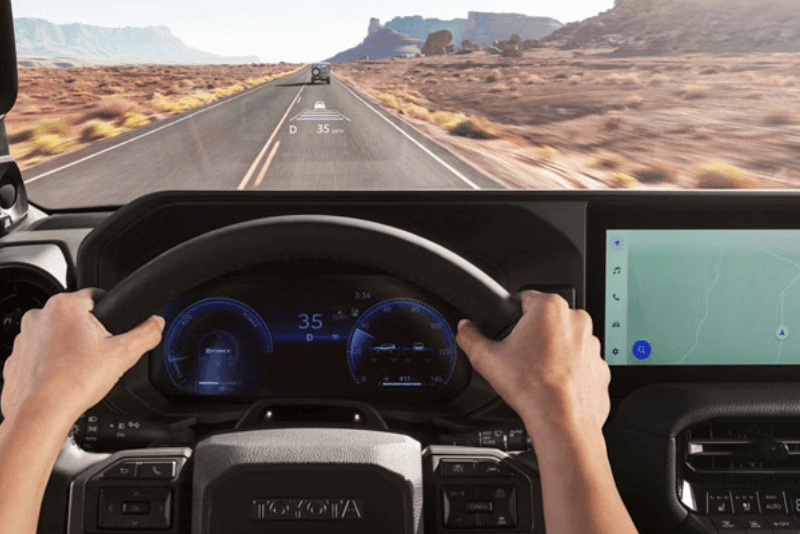
What Features Are Included in Toyota Safety Sense 3.0 Standard Equipment?
Toyota Safety Sense 3.0 includes seven core driver-assist technologies as standard equipment on 2026 Toyota vehicles: Pre-Collision System with Pedestrian Detection, Dynamic Radar Cruise Control, Lane Departure Alert with Steering Assist, Lane Tracing Assist, Road Sign Assist, Automatic High Beams, and Proactive Driving Assist. Together, these systems monitor surrounding traffic, road boundaries, and overhead signage to support safer vehicle operation.
The core technology relies on an advanced sensor array that upgrades both hardware resolution and detection range over earlier system releases:
- Pre-Collision System with Pedestrian Detection: Scans for preceding vehicles, pedestrians, bicyclists, and motorcyclists. Upgraded intersection support detects oncoming traffic across multiple lanes when making left or right turns, automatically applying emergency braking if a collision risk is identified. In independent vehicle-to-vehicle testing conducted by the Insurance Institute for Highway Safety (IIHS), the system successfully avoided collisions at speeds up to 43 mph.
- Full-Speed Range Dynamic Radar Cruise Control: Offers four selectable following-distance settings and smooth speed tracking down to a complete stop, automatically resuming pace when traffic moves forward.
- Lane Tracing Assist: Works alongside cruise control to provide continuous lane-centering steering guidance. On updated 2026 applications, it adds subtle lateral offset distance when passing large commercial trucks or oversized vehicles in adjacent lanes.
- Proactive Driving Assist: Provides gentle automatic deceleration into sharp curves and subtle distance-keeping braking behind vehicles or pedestrians without requiring cruise control activation.
- Lane Departure Alert with Steering Assist: Detects road edges, guardrails, and painted lane markings, delivering audio/visual alerts and gentle steering corrections if unintentional drifting occurs.
- Road Sign Assist and Automatic High Beams: Read speed limits and stop signs to display them on the driver instrument panel while automatically toggling high beams based on oncoming headlights.
This robust package is included across standard trims without forcing buyers into expensive option packages. Drivers researching older model years or cross-shopping value choices can explore our pre-owned vehicle selection to compare feature generations across various body styles.
How Does TSS 3.0 Perform on Rural Roads, Highway Commutes, and Bad Weather?
Toyota Safety Sense 3.0 performs exceptionally well on two-lane rural roads and secondary highways because its upgraded sensors identify 3D roadside objects like guardrails and detect oncoming vehicles during turns, rather than relying solely on painted lines. On open highways and during adverse weather, its combined camera and radar technology maintains reliable vehicle tracking where vision-only systems often fail.
Driving along rural routes around Mount Pleasant presents distinct challenges, including gently rolling terrain, narrow two-lane asphalt, and unpaved shoulders where painted lines are frequently worn away. While earlier driver-assist systems required clearly painted white lines to function, Toyota Safety Sense 3.0 uses 3D object recognition to track physical road boundaries such as grass lines, gravel shoulders, and guardrails. Combined with Proactive Driving Assist, the system can help modulate speed when approaching tighter bends, giving rural drivers smooth, predictive support.
On high-speed interstate corridors, Full-Speed Range Dynamic Radar Cruise Control and Lane Tracing Assist transform tedious driving into a relaxed experience. The system calculates lead-vehicle deceleration smoothly, avoiding the sudden, erratic braking that plagued older adaptive cruise systems. Inside a spacious cabin equipped with available supple leather seating, long highway stretches feel like a serene oasis on the road, allowing drivers to reach their destinations relaxed and alert.
Night driving and light weather challenges are similarly well-managed. In IIHS nighttime pedestrian crash prevention testing, vehicles equipped with Toyota Safety Sense 3.0 successfully recognized adult pedestrians in complete darkness at speeds up to 25 mph, issuing driver warnings more than two seconds prior to potential impact. For families shopping for well-maintained, late-model options, reviewing our certified pre-owned Toyota inventory provides access to factory-backed vehicles outfitted with these safety technologies.
Does Radar and Over-the-Air Update Support Give TSS 3.0 an Advantage?
Combining millimeter-wave radar with a high-resolution camera gives Toyota Safety Sense 3.0 a distinct operational edge in heavy rain, fog, and road spray compared to optical-camera-only setups like Subaru EyeSight. Furthermore, TSS 3.0 features a modular architecture that supports over-the-air software updates, enabling remote system enhancements without requiring a dealership visit.
Optical cameras rely entirely on visual clarity, meaning heavy downpours, sea fog, dense road spray, or direct windshield glare can blind camera-only safety systems. Millimeter-wave radar emits radio frequency waves that travel through atmospheric precipitation and airborne debris, allowing Toyota Safety Sense 3.0 to maintain accurate distance tracking to the vehicle ahead even when environmental visibility drops.
The integration of over-the-air (OTA) software update support safeguards long-term vehicle technology. Rather than driving hardware that becomes fixed the moment it leaves the assembly plant, 2026 Toyota models receive wireless updates that refine sensor algorithms, enhance object recognition speed, and optimize braking responses. Owners preparing to step into a newer vehicle can value your trade-in online to see how current vehicle equity applies toward upgrading to a TSS 3.0-equipped model.
What Habits Help Drivers Get the Most Benefit and Lower Daily Stress?
Drivers maximize the benefits of Toyota Safety Sense 3.0 by customizing its four following-distance settings, understanding how Proactive Driving Assist delivers subtle braking assistance, and maintaining a clear camera field of view on the upper windshield. Developing these habits allows the system to act as a seamless co-pilot, significantly reducing physical and mental strain during high-density stop-and-go driving.
Commuters navigating daily traffic bottlenecks through Spring Hill on I-65 often note that adjusting safety settings to match personal driving styles changes their entire perception of rush-hour travel. Setting the radar gap to a closer setting in slow stop-and-go traffic prevents aggressive drivers from cutting in, while selecting a wider gap at highway speeds creates a comfortable cushion.
To get the most benefit out of daily driving, owners should follow four key practices:
- Customize Radar Following Distance: Toggle the steering-wheel-mounted distance button to match current traffic speed and density.
- Understand Proactive Driving Assist: Recognize that gentle deceleration when coasting toward curves or preceding traffic is normal system operation, not a mechanical fault.
- Keep Sensor Zones Clean: Ensure the upper windshield area in front of the optical camera and the front grille emblem covering the radar unit remain clear of heavy mud, ice, or bugs.
- Maintain Active Supervision: Treat TSS 3.0 as a supportive driving aid that handles routine inputs while keeping hands on the wheel and eyes on the road.
Understanding these operational nuances makes daily travel noticeably smoother. Buyers ready to explore monthly budget options can easily apply for financing online before taking a test drive.
Common Questions About Toyota Safety Sense 3.0 Performance
Q: Can Toyota Safety Sense 3.0 make long-distance travel noticeably easier for owners?
Yes, long-distance highway travel is significantly less tiring because Full-Speed Range Dynamic Radar Cruise Control and Lane Tracing Assist handle routine speed adjustments and gentle steering corrections. On vehicles like the 2026 Toyota Highlander, which features a 243 hp hybrid powertrain and seating for up to seven passengers, these driver aids allow the driver to maintain focus without experiencing the physical fatigue associated with hours of continuous manual throttle control and lane tracking.
Q: What types of real-world crashes does Toyota Safety Sense 3.0 help reduce the most?
TSS 3.0 is most effective at preventing rear-end collisions, pedestrian impacts, lane-drift sideswipes, and turning-path accidents at intersections. By combining automatic emergency braking with intersection collision avoidance, the system mitigates hazards during turning maneuvers across oncoming lanes and automatically applies braking force if a preceding vehicle stops suddenly.
Q: Does Toyota Safety Sense 3.0 work effectively during night driving?
Yes, TSS 3.0 maintains high operational effectiveness at night thanks to an upgraded forward camera with enhanced low-light sensitivity paired with millimeter-wave radar. In standard IIHS pedestrian avoidance tests, vehicles equipped with TSS 3.0 successfully detected adult pedestrians in nighttime conditions at speeds up to 25 mph and issued collision warnings more than two seconds prior to potential impact.
Q: How does Proactive Driving Assist differ from traditional collision warning systems?
Traditional collision warning systems only intervene when an immediate crash risk is detected, whereas Proactive Driving Assist operates continuously in everyday driving scenarios. It provides gentle, automatic deceleration and minor steering nudges when approaching curves or keeping distance from preceding vehicles, pedestrians, or cyclists, even when cruise control is turned off.
Q: Does heavy weather cause Toyota Safety Sense 3.0 to temporarily turn off?
While millimeter-wave radar penetrates light rain and fog better than camera lenses, extreme weather conditions such as heavy downpours, severe snow accumulation, or thick mud covering the front emblem and upper windshield can temporarily limit sensor visibility. When sensors are blocked, the vehicle displays a driver multi-information display notification and safely pauses active driver-assist functions until conditions clear.
Vehicle information, pricing, features, specifications, fuel economy, safety ratings, availability, and comparisons are provided for informational purposes only and may vary by model year, trim level, package, drivetrain, and manufacturer updates. MSRP excludes taxes, title, license, registration, dealer fees, destination charges, and optional equipment unless otherwise stated. Fuel economy estimates are based on EPA ratings where available, and actual mileage will vary. Feature availability and safety technologies may differ by trim and configuration.