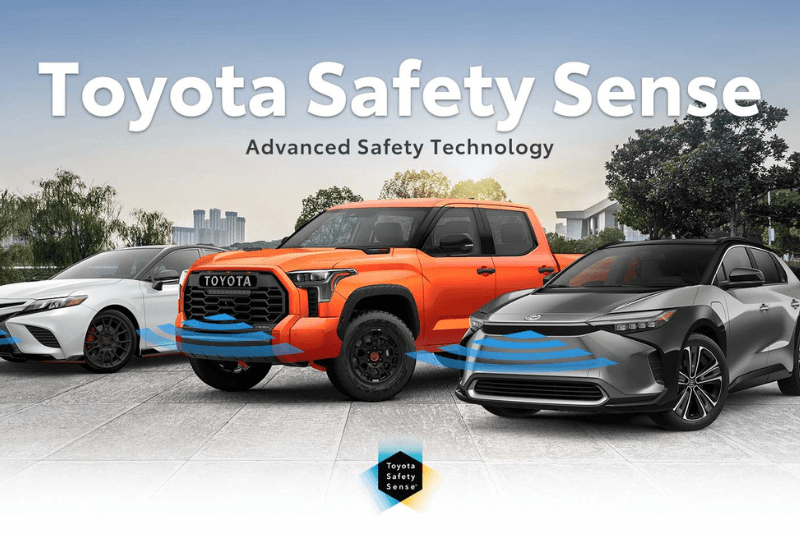
Toyota Safety Sense 3.0 includes a comprehensive suite of active safety technologies: Pre-Collision System with Pedestrian Detection, Full-Speed Range Dynamic Radar Cruise Control, Lane Departure Alert with Steering Assist, Lane Tracing Assist, Road Sign Assist, Automatic High Beams, and Proactive Driving Assist. These integrated systems use forward-facing cameras and radar sensors to deliver visual and audible warnings while applying steering or braking support to reduce collision risks.
Toyota designs this suite of active safety features to act as an extra set of eyes on the road. Rather than hiding essential driver-assist technologies behind expensive add-on packages, Toyota equips Toyota Safety Sense 3.0 as standard equipment on core vehicles like the 2026 Toyota Camry and 2026 Toyota Corolla. Depending on the model, this suite is often paired with complementary technologies like a Blind Spot Monitor and Traffic Jam Assist to simplify heavy stop-and-go driving.
When shopping for a family vehicle, knowing that these active protective systems come standard brings genuine peace of mind. To explore these features in person, shoppers can drop by our showroom at 1027 Nashville Hwy, Columbia, TN 38401 for a complete vehicle walk-around, or give our team a quick call to learn which models include this suite on our lot. You can also view our showroom location and driving route to plan your visit.
What Camera and Radar Hardware Upgrades Power TSS 3.0?
The hardware powering Toyota Safety Sense 3.0 features upgraded forward-facing camera sensors with expanded horizontal and vertical viewing angles, paired with a refined millimeter-wave radar unit that extends forward detection distance. These upgraded components allow the vehicle's onboard logic to interpret complex surroundings faster and detect objects across much broader angles than previous system generations.
Compared to earlier setups like TSS 2.5, the widened field of view significantly improves performance at busy junctions and cross streets. The system detects oncoming traffic, bicyclists, and pedestrians earlier when preparing to make a turn across multi-lane roads. For drivers navigating busy intersections in Columbia, this expanded perimeter sensing provides an added buffer against sudden hazards during peak morning or afternoon travel.
The higher-resolution camera lens also reads road markings and traffic signs with greater accuracy under challenging lighting conditions, such as driving into direct sunrise or through heavy rain. If you are thinking about upgrading from an older model, you can value your trade-in online before browsing our selection of new vehicles to find a model equipped with these hardware enhancements.
How Does Lane Tracing Assist and Emergency Driving Stop System Work in TSS 3.0?
Lane Tracing Assist in Toyota Safety Sense 3.0 differs from previous versions by using enhanced lane recognition logic, 3D line tracking, and an expanded sensor field of view to keep the vehicle centered with smoother steering inputs on curved roads or when lane lines are partially faded. Working in tandem, the Emergency Driving Stop System monitors driver attentiveness while lane centering is active, issuing alerts and bringing the vehicle to a controlled stop with hazard lights flashing if the driver stops responding.
In earlier safety suites, lane-centering systems relied primarily on 2D visual tracking of clear painted lines. In Toyota Safety Sense 3.0, Lane Tracing Assist evaluates the surrounding road geometry, tracking the path of preceding vehicles and recognizing road edges like curbs or gravel shoulders even when painted markers disappear. The steering adjustments are refined to avoid jerky corrections, creating a calm, natural sensation in the steering wheel.
The Emergency Driving Stop System acts as a crucial safety net for long highway drives. If a medical emergency or extreme fatigue prevents the driver from making steering inputs, the system initiates progressive audio and visual warnings. If those alerts go unanswered, it gently decelerates the vehicle within its lane, brings it to a complete halt, unlocks the doors, and turns on the hazard lights to alert nearby motorists and emergency responders. Drivers interested in exploring these lane-support technologies in pre-owned models can check our current pre-owned inventory for late-model options equipped with active driver assistance.
What Is Proactive Driving Assist and How Can Drivers Adjust Its Settings?
Proactive Driving Assist is a driver-assistance feature in Toyota Safety Sense 3.0 that provides subtle, automatic braking and steering inputs during everyday driving to help maintain safe distances from preceding vehicles, pedestrians, or bicyclists, while offering gentle deceleration into sharp curves. Drivers can adjust feature sensitivity or toggle individual functions on and off using the steering-wheel controls to access the vehicle's multi-information display settings menu.
Unlike Full-Speed Range Dynamic Radar Cruise Control, which only operates when cruise control is engaged, Proactive Driving Assist works continuously during normal suburban driving. The system includes Deceleration Assist, which eases off the throttle and applies mild brake pressure when approaching a slower vehicle ahead or entering a sharp bend in the road, reducing the constant pedal movement typically required in traffic.
When local drivers visit us for a test drive, they usually ask how Proactive Driving Assist feels during normal deceleration before they even ask about highway cruise control. The intervention is smooth and predictable, feeling like an attentive co-pilot rather than an abrupt intrusion. For drivers who prefer less automated feedback, the sensitivity levels can be set to low, medium, or high, or disabled entirely through the vehicle settings menu. Shoppers looking for low-mileage vehicles featuring these cabin controls can explore our certified pre-owned inventory to test out these display menus in person.
How Does TSS 3.0 Protect Families in SUVs Like the RAV4 and Camry?
Toyota Safety Sense 3.0 helps support drivers in models like the 2026 Toyota RAV4 and 2026 Toyota Camry by continuously monitoring surrounding traffic, helping identify potential hazards at intersections, and providing driver-assist intervention when necessary. Combined with strong structural safety ratings—including the 2026 RAV4 earning a 5-star overall safety rating from NHTSA—this suite helps lower driver fatigue and provides an extra layer of protection during daily family driving.
In practical terms, this active safety technology reduces the stress of school drop-offs, weekend errands, and family road trips:
- Intersection Turning Protection: Detects oncoming vehicles or pedestrians crossing the street when turning left or right at traffic lights.
- Pedestrian and Cyclist Detection: Uses wide-angle camera sensing to spot bicyclists or pedestrians near the edge of the roadway during day or low-light conditions.
- Smooth Speed Control: Full-Speed Range Dynamic Radar Cruise Control manages distance smoothly in heavy highway traffic, bringing the vehicle to a full stop and resuming speed automatically.
- Spacious Cabin Comfort: Complements protective features with family utility, such as the RAV4 offering about 38 cubic feet of rear cargo space and an available hybrid powertrain making 236 hp with 46 city / 39 hwy mpg.
For sedan buyers, the 2026 Toyota Camry pair safety with efficiency, featuring an available all-wheel drive hybrid setup producing 232 hp while delivering 51 city / 49 hwy mpg. When you are ready to explore your buying options for a family vehicle equipped with these safety features, our finance team can help you apply for financing online to find a payment structure that fits your household budget.
Key Questions About Toyota Safety Sense 3.0 Answered
Q: Is Toyota Safety Sense 3.0 standard on new Toyota models?
Toyota Safety Sense 3.0 comes as standard safety equipment on core 2026 Toyota models, including the Camry and Corolla, as well as popular family crossover choices. Unlike some vehicle brands that require buyers to add expensive luxury option packages to access active safety technology, Toyota includes these features as standard on many models and trims.
Q: Can drivers adjust or turn off specific TSS 3.0 features?
Drivers can customize alert volumes, adaptive cruise control following distances, and sensitivity levels for systems like Lane Departure Alert and Proactive Driving Assist. Using the vehicle's steering-wheel buttons and the multi-information display menu, drivers can tailor system responsiveness to match their personal driving preferences or switch off individual assistance features whenever desired.
Q: What maintenance steps help keep TSS 3.0 sensors working properly?
Keeping Toyota Safety Sense 3.0 operating properly requires keeping sensor surfaces clean and unobstructed. Vehicle owners should regularly wipe away dirt, bugs, mud, snow, or ice from the top section of the front windshield where the camera lens sits, as well as the front grille emblem that houses the millimeter-wave radar module.
Q: Does TSS 3.0 detect obstacles at wider angles than TSS 2.5?
Toyota Safety Sense 3.0 utilizes upgraded forward cameras with wider horizontal and vertical fields of view, along with an expanded millimeter-wave radar sensing range. This wider detection angle enables the safety suite to identify oncoming vehicles, pedestrians, and bicyclists earlier when turning at intersections or when obstacles enter the road from adjacent lanes.
Q: What documents should buyers bring when trading in a vehicle at the dealership?
When bringing a vehicle in for a trade appraisal and purchase, buyers should bring the vehicle title or current payoff documentation, valid vehicle registration, proof of active auto insurance, and all sets of keys or entry fobs. Having these documents ready helps streamline the trade-in appraisal and vehicle financing process.
Vehicle information, pricing, features, specifications, fuel economy, safety ratings, availability, and comparisons are provided for informational purposes only and may vary by model year, trim level, package, drivetrain, and manufacturer updates. MSRP excludes taxes, title, license, registration, dealer fees, destination charges, and optional equipment unless otherwise stated. Fuel economy estimates are based on EPA ratings where available, and actual mileage will vary. Feature availability and safety technologies may differ by trim and configuration.