The 2027 Toyota Sequoia is expected to deliver a maximum towing capacity of up to 9,520 lbs when properly equipped in its rear-wheel-drive configuration. Four-wheel-drive models offer a maximum tow rating between 8,980 lbs and 9,120 lbs depending on trim, while the off-road-focused TRD Pro trim is rated for up to 9,020 lbs, making the hybrid SUV well-suited for heavy trailers and agricultural equipment.
For families and local agricultural exhibitors hauling equipment to the Maury County Fairgrounds, having a vehicle built on a high-strength fully boxed steel frame makes a noticeable difference. The hybrid full-size SUV matches heavy-duty structural rigidity with smooth road manners, providing total peace of mind when trailering livestock, grain hoppers, or utility trailers across Columbia during the busy fall harvest season. Whether navigating tight parking areas near the Duck River or cruising along rural highways, the SUV delivers robust pulls without straining.
Toyota achieves this towing strength by pairing a boxed frame with a modern multi-link rear suspension and standard Class IV towing equipment. A standard hitch receiver, seven-pin/four-pin connector harness, and integrated trailer brake controller come factory-installed, eliminating the need for aftermarket modifications before your first big haul.
To explore current trailering configurations or inspect a setup in person, buyers can find our Columbia showroom address online or give our team a quick call to learn more about upcoming arrivals.
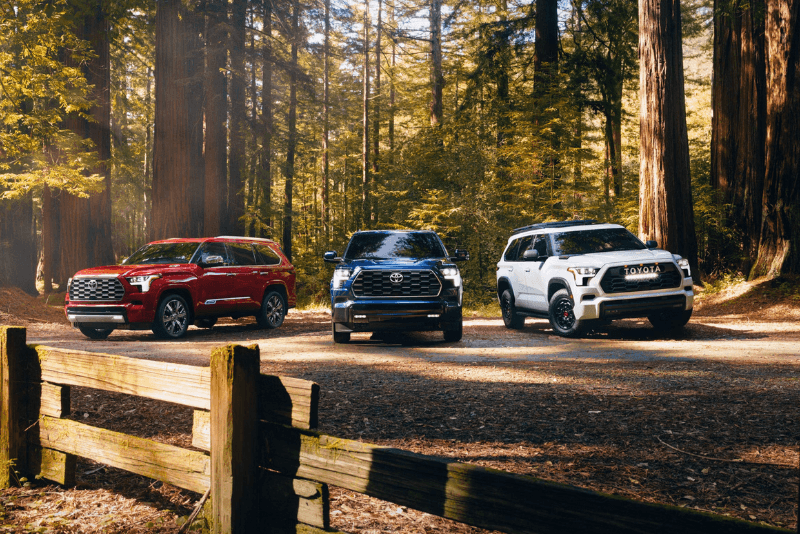
Which Toyota Sequoia Trim and Drivetrain Offer the Highest Towing Capacity?
The SR5 trim in two-wheel drive achieves the highest maximum towing capacity in the Sequoia lineup at 9,520 lbs. Stepping up to trims like the Limited, Platinum, 1794 Edition, and Capstone or adding four-wheel drive slightly reduces maximum trailer ratings due to additional vehicle curb weight.
Selecting the ideal trim level depends on how you balance maximum pull ratings with interior comfort for your family. The entry-level SR5 trim carries the lowest curb weight, which unlocks the absolute peak towing limit. Stepping up to the Limited trim maintains a high tow rating of 9,300 lbs in rear-wheel drive while adding upgraded amenities like ventilated front seating and a hands-free power liftgate.
Adding four-wheel drive introduces a transfer case and front-axle hardware that adds curb weight, adjusting the towing capacity slightly across the board:
- SR5 RWD: 9,520 lbs (4WD: 9,120 lbs)
- Limited RWD: 9,300 lbs (4WD: 9,010 lbs)
- Platinum RWD: 9,100 lbs (4WD: 8,980 lbs)
- 1794 Edition RWD: 9,100 lbs (4WD: 8,980 lbs)
- TRD Pro 4WD: 9,020 lbs
- Capstone RWD: 9,180 lbs (4WD: 8,980 lbs)
Even at the 8,980 lb threshold on top-tier four-wheel-drive models, the vehicle easily handles double-axle horse trailers, large speedboats, and heavy recreational vehicles. For shoppers interested in comparing pre-owned full-size SUVs or prior model years, exploring our pre-owned vehicle inventory provides a clear view of available trailering options across various price points.
What Engine and Powertrain Power the Sequoia for Heavy-Duty Towing?
Every Sequoia is powered by the i-FORCE MAX twin-turbo V6 hybrid powertrain, delivering 437 hp and 583 lb-ft of torque through a 10-speed automatic transmission. This hybrid system places an electric motor generator between the 3.4-liter twin-turbo engine and the transmission, providing immediate low-end torque for smooth off-the-line trailer launching.
Unlike traditional non-hybrid V8 engines that require high RPMs to reach peak pulling power, the i-FORCE MAX setup generates its full 583 lb-ft of torque at just 2,400 RPM. The electric motor fills in boost lags instantly, giving drivers linear power delivery when pulling heavy loads up steep highway inclines or through soft farm soil.
The 10-speed automatic transmission features dual Tow/Haul driving modes. Standard Tow/Haul mode adjusts shift points to optimize power delivery for lighter loads, while Tow/Haul+ recalibrates throttle response and holds lower gears longer for heavy trailers exceeding 5,000 lbs. Downshift logic also provides automatic engine braking during downhill descents to reduce brake wear.
This hybrid configuration delivers remarkable efficiency alongside its pulling strength. Rear-wheel-drive models achieve an EPA-estimated 22 mpg combined ( 21 mpg city / 24 mpg highway), outperforming traditional non-hybrid rivals like the Nissan Armada, whose 3.5-liter twin-turbo V6 yields 16 mpg city / 20 mpg highway while producing 425 hp and 516 lb-ft of torque.
If you are planning to upgrade your current truck or family vehicle before fair season, you can value your trade-in online to see how your vehicle's equity applies toward a new hybrid SUV.
What Advanced Towing Tech Does the Sequoia Offer That Rivals May Not?
The Toyota Sequoia incorporates specialized trailering technology, including available power-extending tow mirrors, an optional wireless trailer camera, and standard Trailer Sway Control integrated with a factory trailer brake controller. Drivers can also opt for a Load-Leveling Rear Height Control Air Suspension to maintain vehicle level and stability when hitching heavy loads.
When buyers walk around the Sequoia on our showroom floor, they frequently ask to see how the digital rearview mirror and panoramic view monitor operate before taking a test drive. The available digital rearview mirror links directly to a rear-facing camera, giving drivers a clear, unobstructed view behind the SUV even when cargo is stacked to the headliner inside the spacious cabin.
Key trailering technologies available on the Sequoia include:
- Power-Extending Tow Mirrors: Power-folding, extending, and retracting mirrors push outward to expand visibility along the sides of wide, enclosed trailers.
- Wireless Trailer Camera: Mounts to the rear of your trailer and streams live video directly to the standard 14-inch multimedia touchscreen.
- Straight Path Assist: Automatically controls steering inputs during reverse maneuvers to keep your trailer backing up in a straight line.
- Load-Leveling Rear Air Suspension: Automatically adjusts rear ride height to offset heavy tongue weights, preserving headlamp alignment and steering control.
For commuters driving from Spring Hill along I-65 with a camper or utility trailer attached, these automated driver aids drastically reduce towing fatigue. Before selecting your preferred package options, you can get pre-qualified online to streamline your buying process.
How Do Passengers and Cargo Impact Actual Towing Capacity for the Maury County Fair?
Adding passengers, cargo, and tongue weight directly reduces the Sequoia's usable towing capacity because every pound loaded into the cabin counts toward the Gross Vehicle Weight Rating ( GVWR). While the vehicle carries a maximum tow rating up to 9,520 lbs, real-world trailer limits must account for a 7,350 lb GVWR and maximum payload allowances.
Every vehicle has a Gross Combined Weight Rating ( GCWR), which represents the total allowable weight of the vehicle, passengers, cargo, fuel, and loaded trailer combined. The Sequoia carries a maximum payload capacity of roughly 1,730 lbs on baseline setups. Tongue weight—the downward force exerted by the trailer coupler onto the hitch ball—typically accounts for 10% to 15% of total trailer weight and subtracts directly from available payload.
For instance, if your trailer exerts a 900 lb tongue weight on the hitch, you have approximately 830 lbs of remaining payload capacity for passengers and gear inside the cabin. If seven family members ride along in seats trimmed in available supple leather seating, their combined weight plus coolers and fair supplies must stay under that 830 lb threshold to remain within safety parameters.
To calculate your actual towing limit for fall harvest hauling, follow these simple steps:
- Locate the vehicle payload rating on the driver door jamb sticker.
- Subtract the total weight of all passengers riding in the cabin.
- Subtract all cargo, aftermarket accessories, and luggage carried inside or on roof racks.
- The remaining figure represents your maximum allowable trailer tongue weight.
- Divide that allowable tongue weight by 0.10 (10%) to determine your real-world maximum trailer weight.
Accounting for passenger and cargo weight ensures your drivetrain, brakes, and tires operate within factory ratings, maintaining a smooth ride that transforms long family trips into a serene oasis on the road.
Common Towing Questions Buyers Ask Before Visiting Roberts Toyota
Q: Do I need to buy a separate tow hitch for the Toyota Sequoia?
No, every Toyota Sequoia comes standard with Class IV towing equipment built directly into the frame structure. This factory setup includes a heavy-duty hitch receiver, a seven-pin/four-pin trailer wiring harness connector, and an integrated trailer brake controller inside the cabin. Buyers do not need to install aftermarket hitches or wiring kits to begin trailering.
Q: What is the maximum towing capacity of the Sequoia TRD Pro trim?
The Sequoia TRD Pro carries a maximum towing capacity of 9,020 lbs. Because the TRD Pro comes standard with four-wheel drive, aluminum skid plates, forged wheels, and heavy-duty 2.5-inch FOX internal bypass shocks, its additional off-road hardware slightly increases curb weight compared to standard SR5 models.
Q: How does four-wheel drive impact fuel economy while towing?
Four-wheel-drive Sequoia models earn an EPA-estimated 19 mpg city / 22 mpg highway, compared to 21 mpg city / 24 mpg highway on two-wheel-drive models. When pulling heavy trailers, fuel economy varies depending on trailer aerodynamics, road grade, and speed, but the hybrid powertrain maintains higher efficiency than non-hybrid V8 engines under load.
Q: What warranty coverage comes with the Sequoia hybrid powertrain?
Toyota backs the Sequoia with a 3-year/36,000-mile basic bumper-to-bumper warranty and a 5-year/60,000-mile powertrain warranty. The i-FORCE MAX hybrid system components are covered for 8 years/100,000 miles, while the traction battery carries a 10-year/150,000-mile factory warranty.
Q: Does the Sequoia require a weight-distributing hitch for maximum trailer loads?
Yes, pulling trailers near the upper weight limits requires a weight-distributing hitch setup. A standard dead-weight hitch supports up to 5,000 lbs trailer weight and 500 lbs tongue weight, whereas a weight-distributing hitch allows the Sequoia to reach its full 9,520 lb trailer capacity and 952 lb tongue weight capacity.