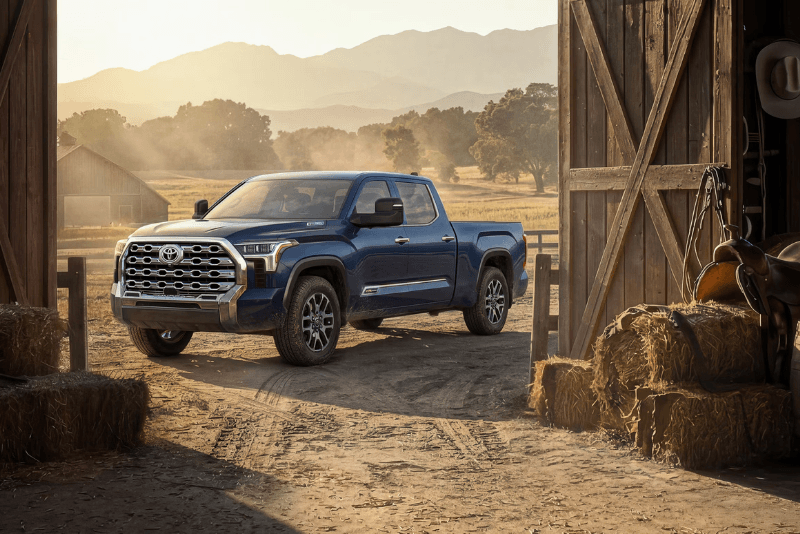
Late summer and early autumn bring a distinct energy to Middle Tennessee as families and farmers prepare for regional traditions. The annual Maury County Fair brings the community together to celebrate local agriculture, livestock, and crafts, requiring a vehicle that can keep up with demanding schedules. Pulling a heavy stock trailer filled with cattle or transporting a flatbed of display equipment requires a truck engineered to handle the job without breaking a sweat. At Roberts Toyota, we know that local drivers need a dependable partner for these demanding seasonal tasks, which is why we point truck buyers toward the capable and durable 2025 Toyota Tundra.
Every current Tundra is built on the high-strength TNGA-F body-on-frame platform. This rigid foundation is engineered specifically to manage heavy tongue weights and maintain stability when navigating around the fairgrounds or hauling supplies down the highway. To make hookups straightforward, all Tundra models come equipped with a standard factory tow hitch featuring integrated 7-pin and 4-pin wiring connectors.
If you are preparing your truck for the busy season ahead, our team is ready to help you inspect your rig and ensure your equipment is ready to roll. You can find our showroom in Columbia, or you can give our service department a quick call to discuss any towing accessories or maintenance needs before you hitch up.
Understanding the Maximum Towing and Payload Limits of the 2025 Toyota Tundra
Understanding the exact limits of your vehicle is the first step toward safe and confident hauling. The maximum towing capacity of the 2025 Toyota Tundra reaches up to 12,000 pounds when properly configured, giving you plenty of capability for livestock trailers, equipment haulers, or larger campers. To achieve this peak rating, the truck must be configured in the double cab style with a 6.5-foot bed, rear-wheel drive, and the standard i-FORCE twin-turbocharged 3.4-liter V6 engine.
Payload capacity is equally critical when loading up supplies for the autumn harvest. For those hauling dense cargo like feed, fencing, or heavy farm displays, the Tundra offers a maximum payload capacity of up to about 1,940 pounds in its standard gasoline configurations. If you opt for the high-output hybrid powertrain, the truck still supports a highly practical payload capacity of over 1,650 pounds.
Because limits vary based on the cabin style, bed length, and trim level, choosing the right configuration is essential. The Tundra lineup spans seven distinct trims: SR, SR5, Limited, Platinum, 1794 Edition, TRD Pro, and Capstone. For example, a heavy-duty work truck might benefit from the utilitarian focus of the SR5, while those seeking a blend of utility and premium comfort often lean toward the Limited or 1794 Edition. If you want to explore these different configurations and find the model that aligns with your work requirements, you can browse our used inventory online to compare available bed lengths and cab options.
Toyota Tundra i-FORCE MAX vs Ford F-150 PowerBoost Hybrid Towing Comparison
Many truck buyers researching hybrid options compare the Tundra hybrid against other light-duty trucks. A common question is how the Tundra i-FORCE MAX hybrid matches up against the Ford F-150 PowerBoost hybrid in real-world capability. Looking at the numbers, the Ford F-150 PowerBoost hybrid offers a maximum towing capacity of up to 11,200 pounds. In comparison, the Tundra i-FORCE MAX hybrid delivers a maximum towing capacity of up to 11,170 pounds.
While the two trucks sit within a mere 30 pounds of each other in maximum towing capacity, the way they deliver power on the road sets them apart. The Tundra i-FORCE MAX hybrid utilizes its twin-turbo 3.4-liter V6 hybrid system to produce 437 horsepower and a massive 583 lb-ft of torque. This substantial low-end torque is engineered to provide immediate, smooth acceleration, which is highly beneficial when pulling a heavy trailer up an incline or getting a loaded rig moving from a complete stop.
Rather than relying on a small electric motor designed primarily for fuel-saving city driving, Toyota integrates the hybrid motor directly within the bell housing between the engine and the 10-speed automatic transmission. This mechanical design ensures that the electric torque works in perfect tandem with the twin-turbo gasoline engine, delivering consistent, linear power that truck owners can feel at the pedal. To see how this hybrid powertrain behaves under acceleration, you can explore our new inventory to find an i-FORCE MAX model ready for a test drive.
Mastering Trailer Back Guidance and Straight Path Assist on the Farm
Backing a trailer into a tight barn stall or down a narrow path near the fertile plains of the Duck River in Columbia can be one of the most stressful parts of farm work. To ease this burden, Toyota offers advanced driver-assist technologies designed to simplify reverse maneuvers. The Tundra’s available Trailer Back Guidance system uses a network of high-resolution cameras and sensors to monitor the trailer’s position, projecting a clear view of your surroundings on the large center touchscreen.
Working alongside this system is Straight Path Assist, a feature that automatically manages steering inputs to keep your trailer backing up in a perfectly straight line. Once you align the truck and trailer and activate the system, the onboard computer calculates the necessary angles and takes over steering wheel adjustments. Your only job is to manage the accelerator and brake pedals, preventing the trailer from jackknifing even on uneven terrain.
Truck buyers who come in for a first look at the Tundra's towing tech usually ask us to demonstrate how the backup cameras align with a coupler before they even take the truck on the road. Seeing the dynamic gridlines adjust in real time gives drivers immediate confidence in their ability to hook up solo. This technology takes the guesswork out of hitching and maneuvering, turning what used to be a two-person job into a simple, stress-free task. If you are thinking about upgrading your current truck to a model equipped with these advanced trailering aids, you can value your trade-in online to see how much equity you can put toward a new Tundra.
A Step-by-Step Guide to Hitch Setup and Weight Distribution Systems
A common mistake when setting up a tow rig is relying entirely on visual appearance. Simply looking at the truck to see if it "looks level" is not a reliable method to confirm proper weight transfer. For a safe and stable tow, a proper setup should be verified with actual measurements, ensuring the front axle remains properly loaded.
When towing a trailer that approaches or exceeds 5,000 pounds, using a weight-distribution hitch is highly recommended to prevent rear-end squat and restore steering control. Setting up this system correctly requires a methodical, step-by-step process:
- Measure the truck unhitched: Park the truck on flat, level ground. Measure and record the distance from the ground to the top of the front and rear wheel arches.
- Hitch the trailer without spring bars: Lower the trailer coupler onto the hitch ball and lock it. Measure the wheel arches again. You will notice the rear of the truck drops while the front rises, which lifts weight off the steering axle.
- Connect and load the spring bars: Attach the weight-distribution bars and tension them according to the manufacturer's instructions.
- Measure the adjusted height: Check the front wheel arch height again. The goal is to return the front ride height as close as possible to the original, unhitched measurement, restoring weight to the front tires for secure steering and braking.
An incorrect setup can lead to severe trailer sway at highway speeds. If the spring bars are too soft, they will fail to transfer sufficient weight; if they are too stiff, they can create a harsh, over-tensioned ride. If you want our certified technicians to inspect your hitch receiver, adjust your weight-distribution system, or perform a pre-towing multi-point inspection, you can easily schedule a service appointment online.
Quick Answers to Common Tundra Towing and Ownership Questions
Q: Does the Toyota Tundra hold its value well over years of heavy use?
The Tundra is widely recognized for its exceptionally strong resale value, consistently retaining its worth over time. This durability is a direct result of the robust TNGA-F body-on-frame platform and the proven reliability of Toyota's engineering. Purchasing a Tundra represents a smart long-term investment, as the truck maintains its value even after years of demanding farm and towing work.
Q: What should I do if I experience a flat tire or mechanical issue while towing?
Every new Tundra comes standard with a manufacturer-backed maintenance and roadside plan, which includes 24-hour emergency support. If you encounter a flat tire, breakdown, or require a tow while hauling your trailer, you can reach out directly to Toyota Roadside Assistance: 1-800-444-4195 for professional, brand-specific support. Our dealership team can also coordinate with the roadside service to ensure your truck is brought to our authorized service center for any necessary repairs using genuine OEM parts.
Q: How do the standard safety features assist when pulling a heavy trailer?
The standard Toyota Safety Sense 3.0 suite includes advanced driver-assist features like pre-collision braking and lane departure assistance that remain active while towing. These systems are calibrated to help you monitor blind spots and maintain a safe distance from leading vehicles, which is crucial when managing the longer stopping distances required for a heavy rig.
Q: Should I adjust my truck's tire pressure before hooking up a large trailer?
Yes, adjusting tire pressure is a critical step because towing increases the load placed on the rear axle. You should check the manufacturer's load inflation table for your specific tires and increase the pressure above the standard empty setting, while staying safely below the maximum PSI listed on the tire sidewall.
Q: How long does the online credit application process take?
Completing our secure online application typically takes only a few minutes when you have your basic financial and employment information on hand. Once submitted, our finance team works quickly to review your file and present personalized auto loan options. You can easily submit a credit application online today to get started on your purchase.
Get Your Tundra Ready for the Fall Harvest
Preparing for the busy autumn season requires a dependable truck and a properly configured towing setup. Whether you are transporting livestock to the fairgrounds, hauling equipment for local businesses near historic downtown Columbia, or loading up the bed with supplies for the fall harvest, the 2025 Toyota Tundra delivers the strength and technology to handle every job with confidence.
Our team at Roberts Toyota is dedicated to helping you find the perfect truck and ensuring it is fully equipped for your specific towing demands. If you are ready to explore your purchasing options, you can prequalify online for an auto loan to streamline your dealership visit. We invite you to stop by our showroom at 1027 Nashville Hwy in Columbia to view our current inventory in person, or give our sales team a quick call to schedule a personalized test drive.