The Toyota Tacoma is a midsize pickup designed for maneuverability, off-road agility, and moderate hauling with a maximum towing capacity of 6,500 pounds and a lower starting price around $34,105. The Toyota Tundra is a full-size pickup engineered for heavy-duty work, offering up to 12,000 pounds of towing capacity, standard twin-turbo V6 power, and a substantially larger cabin starting around $41,260. While official specifications for the 2027 model year have not been detailed by Toyota, both trucks are expected to build on their current design platforms.
Choosing between these two trucks comes down to matching vehicle dimensions and mechanical capability with your daily driving routine. The midsize Tacoma excels in tight parking areas, suburban garages, and narrow backcountry trails. Its responsive handling and efficient powertrain options make it a versatile option for drivers who want truck capability without full-size exterior bulk.
By contrast, the Tundra provides maximum interior hip and legroom, greater gross vehicle weight ratings, and higher payload thresholds. If your daily demands involve pulling heavy equipment trailers, carrying large work crews, or taking long family road trips with a heavy travel trailer in tow, the full-size frame of the Tundra offers the necessary stability and power reserves.
Our team at Roberts Toyota is ready to walk you through both vehicle lineups, compare trim features side by side, and arrange back-to-back test drives on local roads. You can stop by our showroom address on Nashville Highway or give our staff a quick call to learn more about upcoming model arrivals.
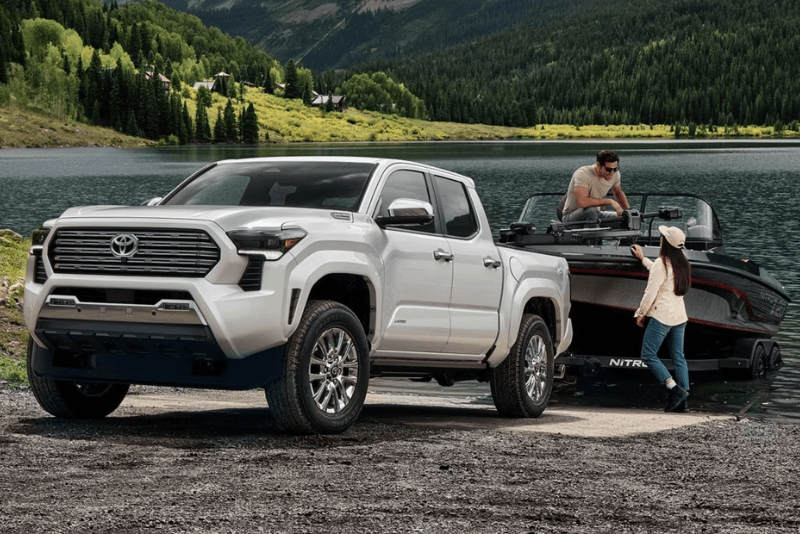
Which Truck Has the Lower Starting Price and Better Value?
Entry-level Tacoma SR models start at about $34,105, making it a more budget-friendly option compared to the Tundra SR's starting price near $41,260. Across every comparable trim level, the midsize Tacoma requires a smaller initial financial investment while delivering standard truck utility.
As you move up the trim ladder, the price gap reflects the underlying hardware differences between midsize and full-size truck platforms:
- Entry-Level Trims: The Tacoma SR ( $34,105) and SR5 ( $37,605) offer practical work-truck utility, whereas the Tundra SR ( $41,260) and Tundra SR5 ( $48,155) include larger cabs and twin-turbo V6 engines standard.
- Mid-Grade & Off-Road Trims: The Tacoma TRD Sport ( $40,315) and TRD Off-Road ( $42,715) provide specialized suspension tuning at price points below the entry-level Tundra hybrid options.
- Hybrid Powertrain Entry: The Tacoma TRD Sport i-FORCE MAX starts around $47,235, while the Tundra Limited i-FORCE MAX begins around $58,560.
- Top-Tier Trims: Specialized off-road models like the Tacoma TRD Pro ( $64,650) and Trailhunter ( $63,650) offer high-end dampening systems while the flagship Tundra Capstone tops the full-size line around $80,800.
Shoppers comparing both trucks on our lot usually look at bed length and entry height before discussing price. For local drivers navigating city streets and launching small boats along the Duck River near Columbia, the lower price point of the midsize truck offers exceptional versatility without requiring a full-size footprint.
To help offset purchase costs, our team can help you value your trade-in online before viewing our current new-vehicle inventory to find current pricing and availability.
How Much Can the Toyota Tacoma and Tundra Tow for Work and Heavy Hauling?
The full-size Tundra provides nearly double the maximum towing performance of the Tacoma, topping out at 12,000 pounds of towing capacity compared to the Tacoma's maximum rating of 6,500 pounds. Payload limits follow a similar pattern, with the Tundra reaching up to 1,940 pounds of bed payload while the Tacoma carries up to 1,710 pounds.
Powertrain specifications explain this variance in pulling capability:
- Tacoma Standard Gas: A 2.4-liter turbocharged four-cylinder engine producing up to 278 horsepower and 317 lb-ft of torque, mated to an 8-speed automatic or 6-speed manual.
- Tacoma i-FORCE MAX Hybrid: Pairs the turbocharged 2.4-liter engine with an electric motor to generate 326 horsepower and 465 lb-ft of torque, maxing out at 6,000 pounds of towing.
- Tundra Standard Gas: A 3.4-liter twin-turbo V6 engine producing up to 389 horsepower and 479 lb-ft of torque through a 10-speed automatic, achieving the peak 12,000-pound tow rating on SR5 RWD double-cab configurations.
- Tundra i-FORCE MAX Hybrid: Combines the twin-turbo V6 with an electric motor for 437 horsepower and 583 lb-ft of torque, providing up to 11,450 pounds of towing power.
On both trucks, selecting the hybrid powertrain increases low-end electric torque for easier acceleration under load, though the added battery weight slightly reduces the overall maximum tow rating. For drivers seeking strong pre-owned capability, reviewing our pre-owned truck selection is a smart way to explore heavy-duty towing options.
Which Truck Gets Better Fuel Economy, Tacoma or Tundra?
The Toyota Tacoma delivers better overall fuel efficiency than the Tundra, achieving EPA estimates of up to 21 mpg city / 26 mpg highway (23 mpg combined) on standard rear-wheel-drive gas models, compared to the Tundra gas model estimates of 18 mpg city / 23 mpg highway (20 mpg combined).
Fuel economy figures across powertrain options highlight the efficiency differences:
- Tacoma Gas 2WD: Up to 21 mpg city / 26 mpg highway.
- Tacoma Gas 4WD: Up to 19 mpg city / 24 mpg highway.
- Tacoma i-FORCE MAX Hybrid 4WD: Up to 22 mpg city / 24 mpg highway.
- Tundra Gas 2WD: Up to 18 mpg city / 23 mpg highway.
- Tundra Gas 4WD: Up to 17 mpg city / 22 mpg highway.
- Tundra i-FORCE MAX Hybrid 4WD: Up to 20 mpg city / 24 mpg highway.
While the hybrid i-FORCE MAX powertrains in both trucks add minimal gains to highway fuel economy, their primary design objective is delivering immediate electric torque during acceleration and towing. Drivers seeking an efficient pre-owned daily driver can explore our certified pre-owned Toyota inventory to find factory-backed truck options.
How Much Bigger Is the Tundra Overall, and Does It Offer More Rear Legroom for Daily Commuting?
The Tundra is approximately 20 inches longer and 4 inches wider than the Tacoma, creating a substantially larger overall physical footprint. In terms of passenger space, the Tundra CrewMax cabin provides 41.6 inches of rear legroom, whereas the Tacoma Double Cab offers 33.7 inches of rear legroom.
Interior dimensions and seating features highlight the cabin contrast:
- Front Headroom & Legroom: Tacoma offers generous front bucket seating, but Tundra provides wider shoulder room and greater center console storage.
- Rear Seat Livability: The Tacoma Double Cab fits children and adults comfortably on shorter drives, but taller passengers will notice lower seat cushions. The Tundra CrewMax rear seat accommodates full-sized adults with stretch-out legroom.
- Cabin Seating Materials: Upper Tundra grades like the 1794 Edition and Capstone feature a spacious cabin with supple leather seating, real wood trim accents, and acoustic glass that transforms the cabin into a serene oasis on the road.
Commuters taking I-65 from Spring Hill each morning will appreciate the extra shoulder room and quieter highway ride of the full-size cab. Buyers interested in exploring flexible monthly financing arrangements can submit an online credit application to begin the pre-approval process prior to visiting us.
How Does Ride Quality Compare Between Tacoma's Coil Springs and Tundra's Air Suspension?
The Tacoma utilizes a multi-link rear coil-spring suspension on most crew-cab models ( SR5 and above) that absorbs small road imperfections while maintaining tight cornering control. Higher Tacoma off-road trims, including the TRD Pro, feature FOX Internal Bypass shocks and front IsoDynamic Performance seats that actively dampen cabin movement over rough washboard trails.
The Tundra uses a rear coil-spring setup standard across its lineup, replacing traditional leaf springs for improved unladen ride comfort. On upper trims such as the Platinum and Capstone, the Tundra offers an optional Adaptive Variable Suspension paired with a load-leveling rear air suspension. This system automatically adjusts shock dampening to smooth out highway expansion joints and levels the rear chassis when carrying heavy payloads in the bed or hitching a trailer.
What Safety Features and Driver Assist Technologies Come Standard on Tacoma vs Tundra?
Both the Tacoma and Tundra come standard with Toyota Safety Sense 3.0, offering an expansive suite of active safety technologies across every trim level:
- Pre-Collision System with Pedestrian Detection: Identifies forward vehicles, cyclists, and pedestrians, applying automatic emergency braking if necessary.
- Full-Speed Range Dynamic Radar Cruise Control: Maintains a preset distance from leading traffic during highway cruising.
- Lane Departure Alert with Steering Assist: Monitors visible road markings and provides gentle steering inputs if inadvertent lane drift occurs.
- Lane Tracing Assist & Road Sign Assist: Keeps the truck centered in its lane while displaying recognized speed signs on the multi-information display.
To see these safety features operating in real-world driving conditions, stop by our dealership address or give our sales staff a quick call to schedule a test drive.
Common Questions About the Toyota Tacoma and Tundra
Q: Is the Tacoma or Tundra easier to park in a standard residential garage?
The Tacoma is significantly easier to fit into standard residential garages and tight parking structures. Measuring roughly 213 inches in length and 78 inches in width, the midsize Tacoma leaves ample walking space inside a standard garage, whereas the full-size Tundra measures up to 234 inches long and over 80 inches wide, often requiring a deep bay.
Q: Do the hybrid i-FORCE MAX engines require a plug-in wall charger?
No, neither the Tacoma nor the Tundra hybrid requires plug-in charging. Both models utilize a self-charging hybrid system that captures electrical energy through regenerative braking during deceleration and stores it in a compact onboard battery to assist the gasoline engine automatically.
Q: What bed lengths are available on the Tacoma and Tundra?
The Tacoma Double Cab offers a choice of a 5-foot or 6-foot bed, while two-door XtraCab configurations come standard with a 6-foot bed. The Tundra offers three bed lengths depending on cab selection: a 5.5-foot short bed, a 6.5-foot standard bed, and an 8.1-foot long bed available on select double-cab work trims.
Q: What warranty coverage comes standard on new Toyota trucks?
Both trucks include a 3-year/36,000-mile bumper-to-bumper warranty, a 5-year/60,000-mile powertrain warranty, and a 5-year/unlimited-mile corrosion perforation warranty. Hybrid models also include specialized hybrid component coverage, alongside 2 years or 25,000 miles of factory-scheduled maintenance.
Q: Which truck is better suited for narrow off-road trails?
The Tacoma is better suited for narrow woodland trails due to its narrower body width and shorter wheelbase. Specialized trims like the Tacoma TRD Off-Road and Trailhunter feature high-clearance bumpers and electronic locking rear differentials designed specifically for tight, technical off-road terrain.
Vehicle information, pricing, features, specifications, fuel economy, safety ratings, availability, and comparisons are provided for informational purposes only and may vary by model year, trim level, package, drivetrain, and manufacturer updates. MSRP excludes taxes, title, license, registration, dealer fees, destination charges, and optional equipment unless otherwise stated. Fuel economy estimates are based on EPA ratings where available, and actual mileage will vary. Feature availability and safety technologies may differ by trim and configuration.